In Writing
Somewhat personal, somewhat communal — from scribbles to verse and documentation of that which would otherwise disappear.
The Gatecrasher in Days
for Coreia Publication, Portugal
It has been precisely one thousand eight hundred and ninety days since our toxic relationship so abruptly began. An uninvited entity crashed into the core of my being, sinking deep into the cells that make up my body.
In The Divided Mind, John E. Sarno describes trauma shock not primarily as a physical injury, but as a psychophysiological event—an interaction between the mind, the autonomic nervous system, and the body. In other words, the mind perceives overwhelming threat, the brain activates the autonomic nervous system—the fight-or-flight response. Oxygen deprivation follows, emotional repression occurs simultaneously, and the body becomes the distraction. Physical symptoms are used to divert attention away from the threatening emotions. When this emotional conflict remains unresolved, the pattern can become chronic.[1]
Four hundred and seventy-nine days ago, in a conversation with the renowned physician Gabor Maté, I spoke about the chronic pain in my spine, and my long journey through a multitude of therapists, healers, and scholars—a journey that had, by then opened for me the world of trauma healing. I told him about my late diagnosis of chronic PTSD and the psychotherapy that came long overdue, years after the trauma itself had occurred.
In Waking the Tiger, Peter A. Levine, who developed Somatic Experiencing in the late 1960s, describes trauma as the result of incomplete biological defensive responses, leaving the nervous system stuck in a flight, fight or freeze state.[2] I asked Dr. Maté about this frozen pain and what I might do to help myself integrate it.
He asked me what I did for it and I said, “Well I try to dance.”
At that moment, I saw a smile form on his lips and a gentle sway in his body. “Well,” he said, “keep dancing—it has helped people heal for centuries.”
Nine hundred and eighty-four days ago, coerced into leaving my hometown for a diasporic life in what was once called the free world, I did so with the intention of creating the final chapter of my 2016 trilogy—Prelude, Damnoosh, and Narges. It took months to reconnect with my body, to identify the many frozen particles lodged in my fascia, and to learn to distinguish between pain and possibility.
[1] Sarno, J. E. (2006). The divided mind: The epidemic of mindbody disorders. HarperCollins.
[2] Levine, P. A. (1997). Walking the tiger: Healing trauma. North Atlantic Books.
Read More here.

Caregiving The Movement, Side Steps In The Den
for TURBA - The Journal for Global Practices in Live Arts Curation
In March 2013, when I left my desk job at the United Nations High Commissioner
for Refugees in Tehran, I did so out of a simple need to contribute more empathy
to the world and, well, do something a bit more humanitarian, if you will. In the
mind of a twenty-four-year-old, changing the world and making it a better place
does not really sound all that grand of an undertaking. Only a few weeks into the
antidepressants prescribed by my mother’s trusted psychiatrist upon leaving my
job, I realized that my body was frozen and my psyche numbed. Time and again,
an abrupt encounter with the self took me back to my roots in the written word,
the world of make-believe, for want of a better word. I gathered myself slowly but
surely on stage, in my body, long lost to a never-appeasing sense of not-knowing.
The curiosity took me on many adventures across the twisted roads of mountainous
Tehran and beyond—from no-name theater classes led by ambitious young makers
to workshops by renowned performers and even singing rock. In July 2013, I ended up on Niavaran Cultural Center’s theater stage in drag, portraying a part of myself that I could not otherwise have been. I would glide across that stage as my skirt would billow with every turn. Many stage nights after that, sometime in 2014, I found myself in a rehearsal space literally two levels beneath the ground somewhere in the center of Tehran. This was an audition for Atefeh Tehrani’s Pina-in-Greek-waters, (Cafe) Lethe, a so-called physical theater piece for eight performers. By entering this river of oblivion, I had in fact entered a forsaken realm, forbidden even, although not in so many words.
Read more here.
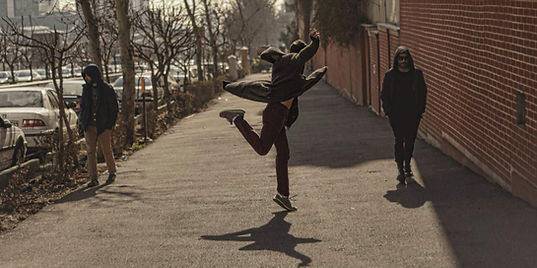
Gratwanderung
Interview on TANZ magazine by Katrin Ullmann
Auf Kampnagel in Hamburg hat er eine Art zweites Zuhause auf Zeit gefunden: Der Choreograf Sina Saberi, aufgewachsen in Iran, engagiert sich für Zeitgenössischen Tanz, der in seiner Heimat buchstäblich ein Schattendasein führt – politisch nicht wohlgelitten. Saberis Arbeiten wurden auf internationalen Festivals von Beirut über Hellerau bis Paris gezeigt. Sein jüngstes Werk «Basis for Being» lädt das Publikum zu einer Zeitreise ein: 1991, eine House Party in Teheran mit außergewöhnlichen Gästen.
Das feinstoffliche Stück hat Saberi als Residenzkünstler von K3 – Zentrum für Choreographie auf Kampnagel entwickelt und im Mai uraufgeführt. Ein Grund mehr, sich dort mit ihm zu treffen.
Sie wurden 1988 in Teheran geboren und sind in den 1990er- und 2000er-Jahren in Iran aufgewachsen. Wann und wie sind Sie zum Tanz gekommen?
Ich habe die Darstellenden Künste für mich relativ spät, erst 2013 entdeckt. Vorher habe ich als Lehrer und 2012 auch für die UN gearbeitet. Aber ich war so frustriert von diesem Bürojob und auch vom Ethos bei der UN, dass ich anfing, Performance-Kurse zu besuchen. Natürlich erfuhr ich dabei aber nie, dass es unter den Darstellenden Künsten auch etwas gibt, das sich ...
Read more here.

Breaking Away
for Movement Research Performance Journal
as Abisa Serin
From a merely somatic point of view, my body was attacked by an external agent which knew very well how to creep inside and settle for some time; that time for me was twenty-seven months and counting…
After a seven-year journey of observing the body every single day, and following the movement wherever it would take you, shaking away the self, so that you are left with only the essence which makes you and the dance. The manifestation of your distillment, the bare gist of your many trans-formations being realized through the simplicity of a body in movement; timelessly present.
Yes, one day it all came to a very abrupt end; only because someone had the malicious audacity to make that happen; bringing movement into stillness. But it wasn’t only stillness, for nothing would ever be calm or uninterrupted after this...
Read more here.

In Conversation with Fatih Genckal
for DOTE Magazine
What do you see happening with you and around you since the beginning of home confinement?
Sina Saberi 25 Apr 2020 20:33
Dear Fatih,
Thank you for this. I will start by answering the first question:
When it started, things were a bit scary and uncertain. I had plans set out until August and one by one they crumbled. Mostly I was worried about the economy of my already precarious life, but also about my long-distance relationship which would now face distance and separation more than it did before. I felt a lot of sorrow and was feeling inclined to fall into some kind of depression and absurdity. For a few days I even did, until one day I decided not to let that happen and found ways to motivate myself every day. I started by making a Yazdi cake which is a traditional Iranian cake for my sister in law who was in her third trimester. The cake came out awesome and I decided to make one every few days in order to perfect it. Now I make a pretty decent Yazdi cake and life goes on. I have gotten more patient since the beginning of it all and even tough I face frustration at least once every few days if not every day, I try to offer myself care. I haven’t always been doing that. Many new things came out of this period actually.
Fatih Genckal 26 Apr 2020 13:55
Read more here.

Always Contextualize
with Ana Vujanović
The book is the result of a theoretical experiment initiated within Practice (Made in Yugoslavia) platform in cooperation with 10 curators of different dance festivals and programmes. The participants were Gigi Argyropoulou, curator of several festivals in Athens; Florian Malzacher, curator of the Impulse Festival in Dusseldorf; Sina Saberi, curator of the festival in Tehran; Christa Spatt, curator of Tanzquartier in Vienna; Agnes Quackels, artistic director of the Buda Arts Centre in Kortrijk, Ana Janevski, curator for performance and new media of the Museum of Modern Art (MoMA) in New York, Dragana Alfirević, curator of Ko-Festival in Ljubljana, Anastasya Proshutinskaya, dance curator of the ZIL Cultural Centre in Moscow, Biljana Tanurovska Kjulavkovski, curator of the Platform programme in Skopje and Marijana Cvetković, curator of the Kondenz Festival in Belgrade.
Read more here.

